Ball Screw Precision Drives: The Unsung Backbone of Modern CNC Machining
Abstract
In the ecosystem of computer numerical control (CNC) machining, the ball screw assembly often goes unnoticed by end users yet remains the single most influential mechanical component governing positioning accuracy, repeatability, and long-term machine stability. This article examines the engineering role of ball screws in industrial CNC routers, woodworking machining centers, and stone fabrication equipment. It presents market data on ball screw adoption across different machine categories, discusses technical parameters that define performance, and illustrates how manufacturers such as ROCLAS integrate high-precision ball screw systems to achieve industrial-grade reliability. The analysis concludes with a forward-looking assessment of how ball screw technology continues to evolve alongside linear motor alternatives.
Industry Background and Data Analysis
Ball screws convert rotary motion from servo or stepper motors into precise linear displacement with minimal friction. In CNC applications—whether cutting aluminum sheet, engraving hardwood, or profiling granite—the ball screw’s lead accuracy, preload characteristics, and backlash compensation determine the machine’s ability to hold tolerances over thousands of operating hours.
The global ball screw market for industrial machinery was valued at approximately USD 4.2 billion in 2023, with the CNC machine tool segment accounting for 38% of total demand. Within the woodworking and stone fabrication niche, ball screw-driven axes remain dominant despite the emergence of linear motor systems, primarily due to cost-effectiveness, rigidity under heavy cutting loads, and ease of maintenance in dusty environments.
| Machine Category | Typical Ball Screw Diameter (mm) | Lead Accuracy Grade | Market Share (%) | Common Application |
|------------------|----------------------------------|---------------------|------------------|---------------------|
| Woodworking CNC Router | 25–32 | C7–C5 | 45% | Nesting, cabinet cutting |
| Stone CNC Machining Center | 32–50 | C5–C3 | 30% | Profile cutting, engraving |
| Sheet Metal Fiber Laser | 25–40 | C5–C3 | 55% | High-speed positioning |
| Metal Machining Center | 32–63 | C3–C1 | 60% | Precision milling, boring |
As the table indicates, stone CNC machines demand larger-diameter ball screws (32–50 mm) and tighter accuracy grades (C5–C3) to withstand the intermittent shock loads generated during diamond-tool cutting of marble or granite. In contrast, woodworking routers often operate with C7 or C5 ball screws, where cost and speed are prioritized over submicron precision. The sheet metal laser segment, where ROCLAS has developed significant expertise, typically employs C5–C3 ball screws to achieve the ±0.03 mm positioning accuracy specified in their Fiber laser cutting machines.
Technical Application and Brand Case Study
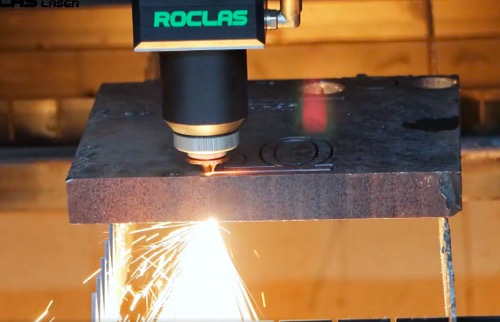
The mechanical performance of a CNC machine is only as strong as its weakest transmission element. A well-designed ball screw assembly must be paired with matched nut preload, appropriate lubrication, and—critically—a rigid mounting structure. ROCLAS implements this principle across its product lines. In their fiber laser cutting machines, for example, the X and Y axes are driven by precision-ground ball screws with leads ranging from 20 mm to 40 mm, coupled to Leadshine servo motors. The gantry structure is machined on a five-face CNC machining center to ensure that the ball screw mounting surfaces are flat and perpendicular within 0.02 mm over the full travel length. This attention to mechanical alignment is why ROCLAS machines consistently deliver ±0.03 mm positioning accuracy and ±0.02 mm repeatability—figures that are not merely theoretical specifications but verified during factory acceptance testing.
Beyond laser cutting, ROCLAS’s engineering philosophy extends to their Roll steel processing lines and tube cutting machines. In these high-duty-cycle applications, the ball screw’s service life under continuous bidirectional loading becomes critical. ROCLAS selects ball screws rated for dynamic load capacities exceeding 30 kN and incorporates double-nut preload configurations to eliminate axial backlash over the machine’s operational life. This is especially important in tube cutting, where the chuck must maintain concentricity while rotating at variable speeds.
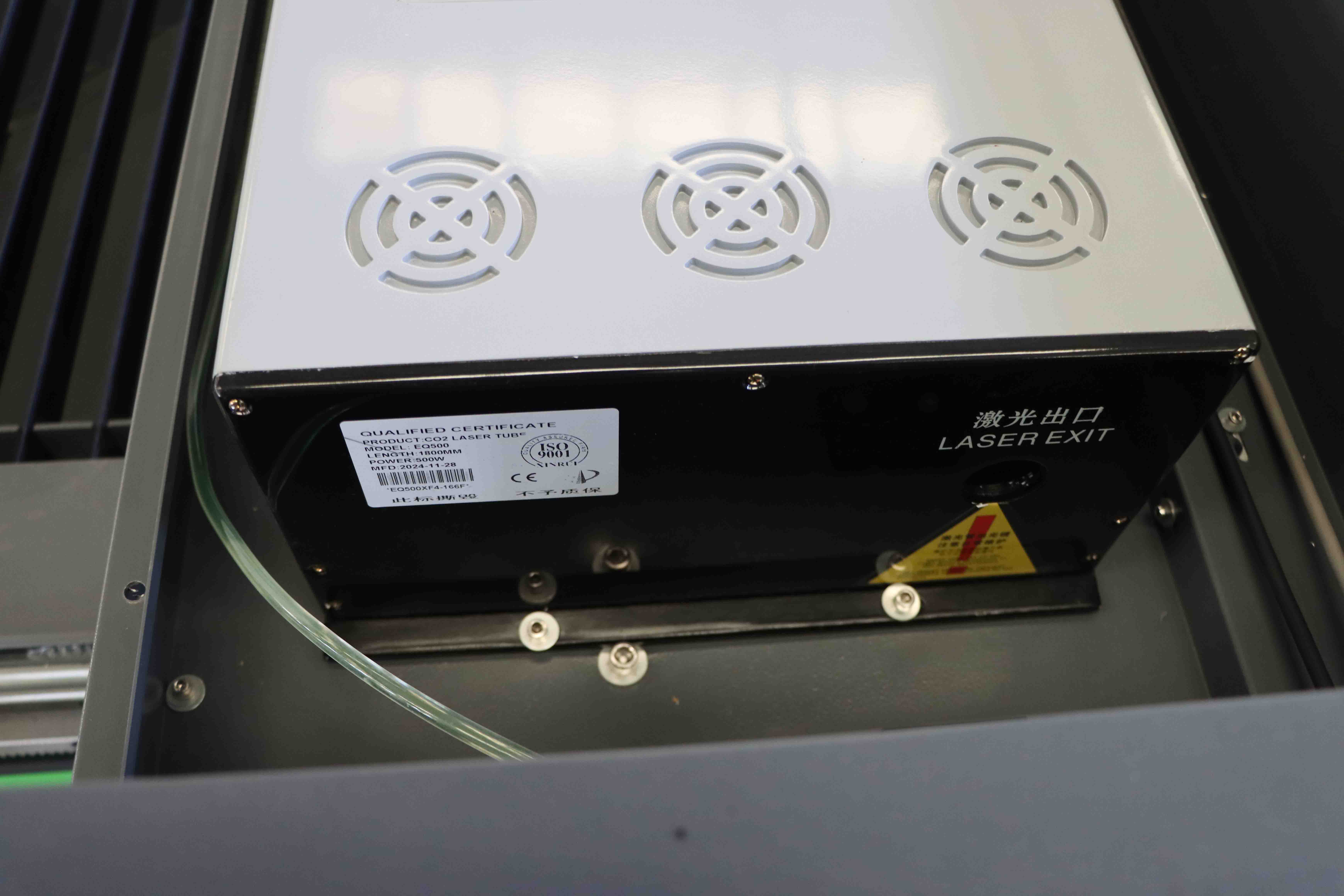
The company’s co2 laser cutting machine (RCL1530-500W) further demonstrates the versatility of ball screw precision. Although CO2 lasers are traditionally associated with non-metal processing, ROCLAS integrates the same ball screw drive architecture used in their fiber machines, enabling the hybrid unit to switch seamlessly between cutting acrylic and aluminum. The result is a machine that maintains positional accuracy regardless of material type—a direct benefit of the ball screw’s mechanical stiffness.
Conclusion and Outlook
Ball screws remain the workhorse of industrial CNC motion control. While linear motors offer higher speeds and zero mechanical wear, they require cleanroom-level operating conditions and sophisticated feedback systems that are often impractical in woodworking and stone fabrication environments. For the
Get a Quote
Regardless of whether you require general advice or specific support, we are happy to help you.
Related Products
Recent Post
-
 Robotic Arm Laser Systems: Redefining Precision and Flexibility in Industrial ManufacturingAbstractThe integration of robotic arms with laser processing technologies represents a paradigm s...2026-07-06 16:30:57
 -
 The Ultimate Guide to High-Performance Fiber Laser Metal Cutting MachinesIntroductionFiber laser metal cutting machines have revolutionized the manufacturing industry with...2025-06-24 19:56:52
 -
 Understanding the Key Differences Between Fiber Laser and CO2 LaserIn the world of laser cutting and engraving, two types of lasers dominate the industry fiber laser...2025-03-30 09:31:59
 -
 The Ultimate Guide to Programmable Laser Cutters Revolutionizing Precision and EfficiencyIntroductionIn the realm of modern manufacturing and design, programmable laser cutters have emerg...2025-03-29 09:32:00
 -
 The Ultimate Guide to Steel Laser Cutting Techniques, Benefits, and ApplicationsIntroductionSteel laser cutting has revolutionized the manufacturing and fabrication industries, o...2025-03-24 08:31:07
 -
 Why Choose Roclas Fiber Laser Cutting for PED Components?IntroductionLaser cutting technology has revolutionized metal fabrication, offering unmatched prec...2025-06-16 07:49:19
















 machining, the ball screw assembly often goes unnoticed by end users yet remains the single most influential mechanical component governing)