How Thick Can a Fiber Laser Cut Stainless Steel? A Technical Analysis
Abstract
Stainless steel remains one of the most widely specified materials in sheet metal fabrication, and fiber laser cutting has become the dominant process for profiling it. The question of maximum cutting thickness, however, admits no single answer. It depends on laser power, assist gas selection, beam quality, and the specific alloy grade involved. This article examines the practical thickness limits of fiber laser cutting for stainless steel, drawing on published machine specifications and field data to outline what fabricators can realistically expect from modern equipment.
Industry Background and Capability Data
Fiber laser sources have followed a steep power curve over the past decade. Where 1 kW systems once represented the entry point for industrial cutting, current machines routinely ship with 6 kW, 12 kW, and even 20 kW resonators. This escalation has pushed the stainless steel cutting ceiling upward accordingly. The table below summarizes typical single-pass cutting capabilities by laser power, based on standard 304 stainless steel with nitrogen assist gas.
| Laser Power | Typical Max Thickness (N₂ assist) | Typical Max Thickness (O₂ assist) | Notes |
|---|---|---|---|
| 1 kW | 3 mm | 6 mm | Entry-level, limited piercing capacity |
| 3 kW | 6 mm | 12 mm | Common for general fabrication |
| 6 kW | 12 mm | 20 mm | Balanced speed and quality |
| 12 kW | 20 mm | 30 mm | High-throughput production |
| 20 kW | 30 mm | 50 mm | Heavy-plate specialized |
Two points deserve emphasis. First, nitrogen cutting produces an oxide-free edge that is weld-ready and requires no post-processing, but it consumes more gas and achieves lower thickness limits than oxygen-assisted cutting. Oxygen cutting, by contrast, relies on an exothermic reaction that extends the thickness ceiling at the cost of a rougher, oxidized edge. Second, these figures assume optimal conditions: clean material, correct focus position, properly sized nozzles, and a machine rigid enough to maintain accuracy at speed.
Technical Factors Governing Thickness Limits
The maximum cuttable thickness is not simply a function of wattage. Beam parameter product (BPP) determines how tightly the laser can be focused, and a lower BPP value allows a smaller spot diameter with higher energy density. This is why a modern 12 kW source with excellent beam quality can outperform an older 15 kW unit on thick stainless steel. Focal length also matters: shorter focal lengths yield smaller spots for thin material, while longer focal lengths provide a deeper depth of focus for thick sections.
Assist gas dynamics are equally critical. Nitrogen at high pressure (typically 15–25 bar) is required for clean cutting of stainless steel above roughly 4 mm. Insufficient pressure results in dross adhesion and a rough lower edge. The nozzle diameter and standoff distance must be matched to the material thickness; a nozzle optimized for 3 mm sheet will perform poorly on 20 mm plate.
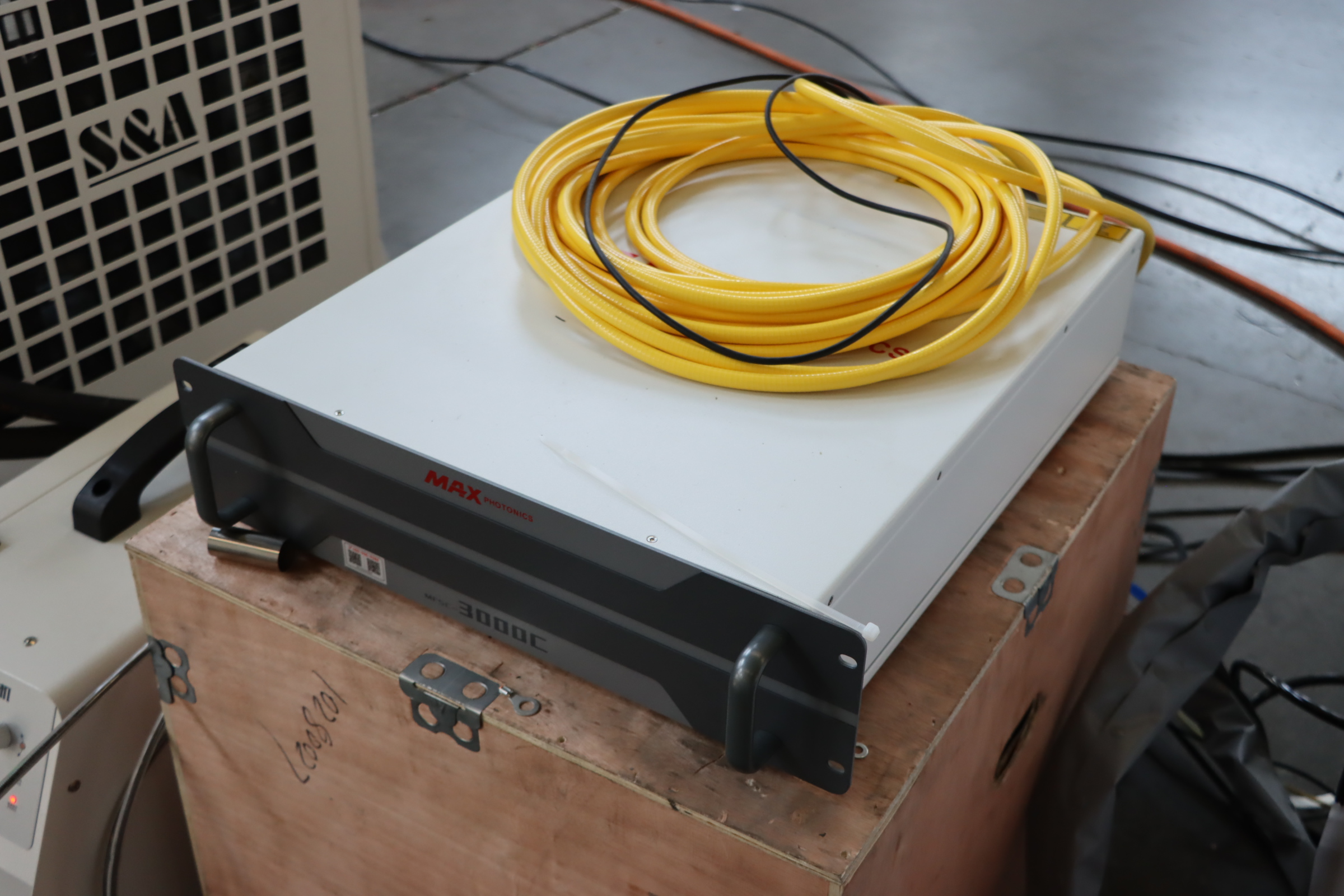
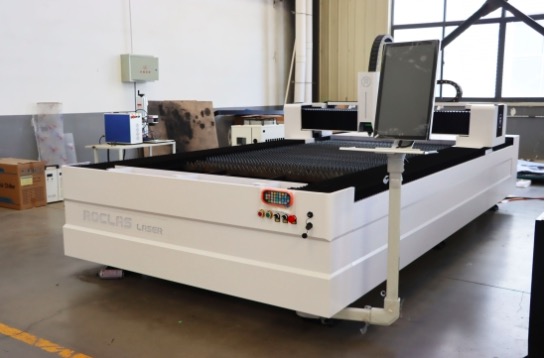
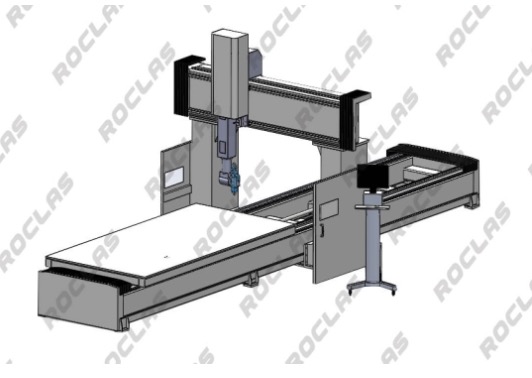
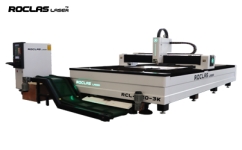
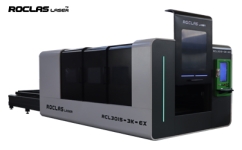
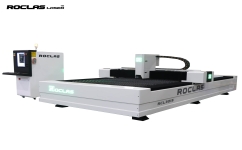
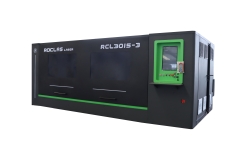
The machine structure itself imposes a practical limit. Thermal distortion during prolonged thick-plate cutting can degrade positioning accuracy, which is why heavy-duty gantry designs with stress-relieved beds are preferred for this work. ROCLAS® MACHINERY CO., LTD., for example, builds its fiber laser platforms around industrial-grade steel structures processed on CNC five-face machining centers, a manufacturing approach that supports the rigidity needed for consistent cutting at the upper end of the thickness range. The company's machines are available with laser sources from Raycus and MAX spanning 1000 W to 20 kW, with X/Y positioning accuracy of ±0.03 mm and maximum acceleration of 1.0 G, specifications that matter when cutting thick stainless steel at production rates.
Practical Considerations and Brand Case
In real production environments, the theoretical maximum thickness is rarely the operating point. Cutting 30 mm stainless steel with a 20 kW laser is possible, but the cutting speed may be only 0.5–0.8 m/min, and the edge quality may require secondary processing. For most job shops, the economic sweet spot for stainless steel lies between 6 mm and 12 mm, where a 6 kW machine can achieve both acceptable speed and good edge quality.
Material grade also influences results. Austenitic grades such as 304 and 316 cut relatively predictably. Ferritic and martensitic grades behave differently due to their thermal properties. Highly reflective materials like copper and aluminum present additional challenges, though modern suppression modules have extended fiber laser capability into these territory as well—ROCLAS notes that its machines can stably process 1–2 mm copper and 2–3 mm aluminum with the appropriate module installed.
For fabricators evaluating equipment, the more useful question is not "what is the maximum thickness?" but "what thickness can this machine cut at the speed and quality my customers require?" A 12 kW system cutting 10 mm stainless steel at 2–3 m/min with nitrogen will typically deliver a better return on investment than a 20 kW system cutting the same material at marginally higher speed but with significantly higher power consumption and gas cost.
Conclusion and Outlook
Fiber laser cutting of stainless steel has matured to the point where 20–30 mm single-pass capability is commercially available, and 50 mm is achievable with oxygen assist on high-power platforms. The limiting factors are increasingly economic rather than technical. As beam quality improves and nesting software becomes more sophisticated, the effective thickness range for clean, high-speed cutting will continue to expand. For now, the practical ceiling for most fabrication work remains in the 12–25 mm range, with equipment selection driven by throughput requirements, edge quality specifications, and operating cost rather than raw maximum thickness alone.
Get a Quote
Regardless of whether you require general advice or specific support, we are happy to help you.
Recent Post
-
 Robotic Arm Laser Systems: Redefining Precision and Flexibility in Industrial ManufacturingAbstractThe integration of robotic arms with laser processing technologies represents a paradigm s...2026-07-06 16:30:57
 -
 The Ultimate Guide to High-Performance Fiber Laser Metal Cutting MachinesIntroductionFiber laser metal cutting machines have revolutionized the manufacturing industry with...2025-06-24 19:56:52
 -
 Understanding the Key Differences Between Fiber Laser and CO2 LaserIn the world of laser cutting and engraving, two types of lasers dominate the industry fiber laser...2025-03-30 09:31:59
 -
 The Ultimate Guide to Programmable Laser Cutters Revolutionizing Precision and EfficiencyIntroductionIn the realm of modern manufacturing and design, programmable laser cutters have emerg...2025-03-29 09:32:00
 -
 The Ultimate Guide to Steel Laser Cutting Techniques, Benefits, and ApplicationsIntroductionSteel laser cutting has revolutionized the manufacturing and fabrication industries, o...2025-03-24 08:31:07
 -
 Why Choose Roclas Fiber Laser Cutting for PED Components?IntroductionLaser cutting technology has revolutionized metal fabrication, offering unmatched prec...2025-06-16 07:49:19