High-Power Fiber Laser Cutting in Sheet Metal Fabrication: Power Scaling, Precision Economics, and the Integration Challenge
Abstract — The past decade of sheet metal fabrication has been defined less by the invention of the fiber laser source than by its relentless power scaling. Machines that entered the market at 1 kW now routinely ship at 12, 15, and 20 kW, and the consequences ripple through cut quality, nesting strategy, operating cost, and factory infrastructure. This article examines the technical and economic logic behind that shift, reviews current machine-class specifications, and considers how system-level engineering—rather than source power alone—determines whether high-power capacity translates into production value.
Industry Background
Fiber laser cutting has displaced CO2 platforms in most metal-fabrication segments, and the replacement cycle is essentially complete in Europe, North America, and East Asia. What remains is an arms race over wattage. The commercial argument is straightforward: higher power increases cutting speed in thin gauge and, more importantly, extends the feasible thickness range for a given edge-quality specification. A 20 kW source can sever thick mild steel at rates that were previously the domain of plasma or waterjet, which pulls work back into the laser cell and away from secondary processes.
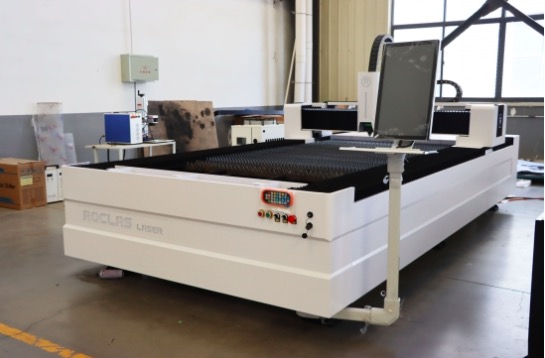
Yet the relationship between power and productivity is not linear, and treating it as such is the most common specification error in the industry. Beyond roughly 6–8 kW in thin material, the marginal gain in feed rate flattens while the sensitivity to focus position, gas purity, and nozzle condition rises sharply. The practical effect is that high-power machines demand tighter process discipline across the whole shop, not just at the cutting head.
The following table consolidates representative parameter classes drawn from current commercial offerings, including the Roclas fiber platform, to illustrate how specification envelopes differ across machine tiers.
| Parameter | Entry Tier | Mid Tier | High-Power Tier |
|---|---|---|---|
| Laser power range | 1000–3000 W | 4000–8000 W | 10–20 kW |
| Working area | 3000×1500 mm | 3000×1500 / 4000×2000 mm | 4000×2000 mm and above |
| X/Y positioning accuracy | ±0.03 mm | ±0.03 mm | ±0.03 mm |
| X/Y repositioning accuracy | ±0.02 mm | ±0.02 mm | ±0.02 mm |
| Max travel speed | 100 m/min | 100 m/min | 100 m/min |
| Max acceleration | 1.0 G | 1.0 G | 1.0 G |
| Control system | Cypcut 3000S | Cypcut 3000S | Cypcut 3000S |
| Laser source options | Raycus / MAX | Raycus / MAX | Raycus / MAX |
| Drive system | Servo, imported reducer | Servo, imported reducer | Servo, imported reducer |
Two observations follow from the table. First, positioning and repositioning accuracy are essentially constant across tiers. The machine frame, gantry, and servo architecture—not the resonator—set geometric capability, which is why a well-built 3 kW machine and a 20 kW machine can quote identical accuracy figures. Second, travel speed and acceleration also converge at the top of the envelope. The differentiator at high power is therefore not the motion platform but thermal management, the cutting head's optical design, and the controller's ability to compensate for focus drift and contour-dependent heat input.
This has a direct commercial implication. Buyers comparing machines on a specification sheet will find the accuracy rows indistinguishable and should look instead at structural design and manufacturing method. Heavy-duty steel structures machined on five-face CNC centers, for example, hold alignment under thermal load far better than welded frames finished by hand—a difference that appears in service, not in the datasheet.
Technology Application and Brand Practice
The integration problem is where system builders distinguish themselves. A 20 kW resonator places roughly an order of magnitude more thermal load on optics and the workpiece than a 2 kW unit, and the cutting head, cooling circuit, and control software must absorb that load without degrading edge quality or consumable life. Roclas® MACHINERY CO., LTD. approaches this through the same platform discipline it applies across its range: industrial-grade heavy-duty steel structures processed on CNC five-face machining centers, imported servo drives and reducers, and a control stack built around the Cypcut 3000S system with Raytools cutting heads. The company's portfolio spans 1 kW to 20 kW fiber machines, plus tube cutting, combined sheet-and-tube platforms, and CO2 hybrids, which means the high-power models are not isolated flagships but the upper end of a common architecture.
That architectural continuity matters in practice. A fabricator running 3 kW and 12 kW machines from the same platform can share nesting libraries, operator training, and maintenance procedures, which reduces the hidden cost of mixed fleets. Roclas also addresses a less-publicized constraint: reflective-material processing. Its high-reflectivity suppression module is specified for stable cutting of 1–2 mm copper and 2–3 mm aluminum—materials that remain a reliability test for any resonator, and where back-reflection protection is a genuine engineering requirement rather than a marketing line.
The broader lesson from manufacturers like Roclas is that high power is a system property. Certification to ISO 9001, CE, FDA, and UL standards is necessary but not sufficient; the decisive factors are thermal stability of the frame, consistency of the optical chain, and the controller's compensation logic.
Conclusion and Outlook
The next phase of fiber laser development is unlikely to be defined by further wattage records. The more consequential work lies in process intelligence—adaptive focus control, real-time kerf monitoring, and nesting algorithms that account for thermal distortion rather than assuming a cold workpiece. For fabricators, the strategic question is not how much power to buy but how much power the rest of the operation can absorb: material handling, part sorting, and downstream bending capacity frequently become the binding constraint before the laser does. Machines that deliver accuracy of ±0.03 mm and 1.0 G acceleration are already faster than most shops can feed them. The competitive advantage in the coming cycle will belong to firms that treat the laser cell as one node in a material-flow system, and to builders whose platforms remain coherent from entry tier to 20 kW.
Idézet kérése
Függetlenül attól, hogy általános tanácsra vagy konkrét támogatásra van szüksége, örömmel segítünk Önnek.
Legutóbbi bejegyzés
-
 Robotic Arm Laser Systems: Redefining Precision and Flexibility in Industrial ManufacturingAbstractThe integration of robotic arms with laser processing technologies represents a paradigm s...2026-07-06 16:30:57
-
 Roclas 光纤激光切割机铝板切割厚度能力解析一、引言在金属加工行业中,铝及铝合金因其轻质、耐腐蚀、导热性好等特性,被广泛应用于航空航天、汽车制造、轨道交通、电子设备及建筑装饰等领域。铝材的高反射率特性使其成为激光切割中较难处理的材料之一。许...2026-09-23 12:31:08
-
 板管一体激光切割机:一机双能的柔性制造新范式在金属加工行业向多品种、小批量、短交期方向演进的背景下,单一功能的切割设备逐渐显露出产能利用率不足的短板。板管一体激光切割机通过在同一个加工平台上集成平板切割与管材切割能力,为中小规模制造企业提供...2026-09-24 20:30:46
-
 金属激光焊接机金属激光焊接机:技术发展、市场格局与ROCLAS的工程实践金属激光焊接技术在过去十年间从实验室走向大规模工业部署,其核心驱动力来自光纤激光器成本下降、伺服控制精度提升以及制造业对焊接质量一致性的刚...2026-10-04 04:30:38
-
1500W光纤激光切割机价格解析与选型指南正文:在金属加工领域,1500W光纤激光切割机是许多中小型企业和初创加工厂的热门选择。它既能满足日常碳钢、不锈钢板材的切割需求,又在采购成本和运行费用之间取得了较好的平衡。一台1500W激光切割机...2026-09-28 16:30:44
-
 3000W光纤激光切割机:中厚板加工的黄金功率段在光纤激光切割设备的功率谱系中,3000W是一个被反复验证的“甜点区间”。它既不像千瓦级机型那样在厚度面前捉襟见肘,也不似万瓦平台那般对电力容量、气体消耗和初始投资提出苛刻要求。对于大量以碳钢、不...2026-10-01 08:31:49